Posted on

The Impact of Cold-Side Oxidation on New England IPA

This homebrew experiment was originally published on Brulosophy.com.

I brewed my first IPA in May of 2003, it was the third batch I made at home using extract and steeping grains. Since then, what I used to think of as typical IPA characteristics have evolved quite a bit. IPA used to be all about packing as much bitterness into a pint as possible, often relying on relatively massive bittering additions using pine-forward hops like Chinook and CTZ, and usually adding a hefty dose of Caramel malt. As craft beer began to grow, tastes swayed more toward the fruitier hops such as Simcoe, Centennial, and Amarillo, and brewers began using more hops later in the process while also moving toward simpler grists that produced a dryer beer. Using such novel techniques as hop-bursting and hop stands, some engaged in experimentation that ultimately led to various “new” styles of IPA including Black, Red, White, Belgian, Triple, Quadruple, Session… you get the idea.

And then, of course, there’s New England IPA (NEIPA), which by my recollection is the latest in the long line of this iterative evolution, a style that stands in near direct contrast to the IPA of my earlier days of brewing. Rather than bitter, piney, crisp, and clear, the best (or most popular) versions of NEIPA are characterized by their low bitterness, “juicy” fruit aromas and flavors, soft and creamy mouthfeel, and perhaps most notably, a hazy appearance. In order to make such a beer, brewers rely on a conglomeration of methods including the use of a good portion of flaked oats and biotransformation dry hopping. Furthermore, while the idea that oxidation expedites the loss of hop character in IPA is nothing new, many brewers of NEIPA also take somewhat extreme measures to reduce their beer’s contact with oxygen. 

Over the last year, I’ve tried my hand at making NEIPA a few times, some of which were rather good and others that almost made me quit the style. The few I’ve liked pretty much mirrored the commercial examples I enjoy in that they maintained a light orange hue reminiscent of fruit juice and had a simple bready malt character. The homebrew and commercial versions of NEIPA I’ve been less than pleased with have all taken on a darker appearance that’s accompanied by an odd caramel-like character that leaves the beer tasting more like a piece of hard candy than a refreshing IPA. What causes this?

Most NEIPA recipes I’ve seen have grain bills absent of malts known to impart much color, and my personal experience proves this darkening can occur even with the simplest of grists. The go-to reason cited by many is oxidation, which I was skeptical of given the results of our xBmts on intentional oxidation at kegging. Following those xBmts, I received feedback from folks positing NEIPA is more sensitive to oxidation for various reasons and that a follow-up xBmt ought to investigate the effect of reducing oxygen exposure on the cold-side when making this style. Challenge accepted!

Purpose

To evaluate the differences between a New England IPA transferred to a CO2 purged keg and the same beer transferred to a non-purged keg.

Methods

All out of Maris Otter, I concocted a blend of pale and Munich malts that I hoped would be somewhat similar then used a rather large portion of flaked oats to make up the rest of the grist.

Hazel New England IPA

Homebrew Recipe Details

Batch Size Boil Time IBU SRM Est. OG Est. FG ABV
5.5 gal 30 min 52.7 IBUs 4.7 SRM 1.058 1.012 6.0 %
Actuals 1.058 1.012 6.0 %

Fermentables

Name Amount %
Pale Malt (2 Row), Rahr 9 lbs 66.67
Oats, Flaked (Briess) 3 lbs 22.22
Munich I (Weyermann) 1.5 lbs 11.11

Hops

Name Amount Time Use Form Alpha %
Simcoe 40 g 15 min Boil Pellet 13.1
Citra 30 g 2 min Boil Pellet 13.8
Galaxy 30 g 2 min Boil Pellet 18.1
Simcoe 30 g 2 min Boil Pellet 13.1
Galaxy 60 g 5 days Dry Hop Pellet 18.1
Citra 30 g 5 days Dry Hop Pellet 13.8
Simcoe 30 g 5 days Dry Hop Pellet 13.1
Galaxy 60 g 1 day Dry Hop Pellet 18.1
Citra 30 g 1 day Dry Hop Pellet 13.8
Simcoe 30 g 1 day Dry Hop Pellet 13.1

Yeast

Name Lab Attenuation Temp.
Juice (A38) Imperial Organic 74% 62°F – 70°F

Notes

Water Profile: Ca 131 | Mg 1 | Na 10 | SO4 62 | Cl 186


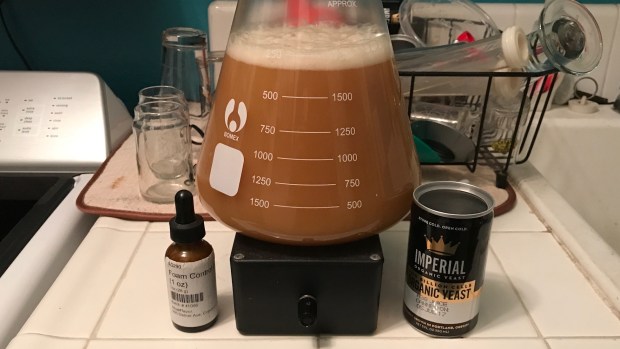
I prepared a starter of Imperial Organic Yeast A38 Juice 2 days ahead of time.

The day before brewing, I weighed out and milled the grains.

Since this would be a 10 gallon batch with a relatively hefty grain bill, I went with the batch sparge method and collected the strike water in my mash tun while the sparge water was placed in my kettle. After adjusting all of the water to my desired profile, I dropped my heatstick into the strike water, placed the cover on the mash tun, then set a timer for it to turn on 1.5 hours before I planned to wake up and brew. I awoke the next morning to required only 5 additional minutes to reach my target strike temperature.

I proceeded to mash in and was quickly reminded of how much thicker the mash is when using the batch sparge method.

A check of the mash temperature showed I was right at my intended 149°F/65°C.

I stole a sample of sweet wort from the mash about 15 minutes in to check how close I was to hitting my 5.4 pH target.

After a 60 minute mash rest, I collected the first runnings of sweet wort and poured it into my boil kettle.

Following a quick batch sparge, the wort was brought to a rolling boil and hops were added as stated in the recipe.

At the completion of the 30 minute boil, I quickly chilled the wort to slightly warmer than my groundwater temperature.


A refractometer reading showed the wort was sitting at my target OG.

1.058 OG

Equal amounts of wort were racked to identical fermentors.

I placed the fermentors in my chamber and gave them a few hours to finish chilling to my desired fermentation temperature of 66°F/19°C before evenly splitting the yeast between them. As I’ve come to expect when using Imperial Organic Yeast, I noticed crazy airlock activity later that day but gave them a full 24 hours before hitting them with a biotransformation dry hop.

I let the beers ferment slightly longer than usual because I wanted to give the low oxygen beer enough time to fully attenuate, as I wouldn’t be taking a FG sample in order to keep oxygen ingress at a minimum. At 8 days post-pitch, I took a hydrometer measurement of the beer going into the non-purged keg that showed FG was hit.

It was time to add the second dry hop charge, which was easy enough for the standard oxygen batch. For the low oxygen beer, I very quickly poured the hops through a small crack between the lid and the fermentor, flushed the headspace with CO2, replaced the lid, then put the fermentor under 1.5 psi of CO2 using something I rigged together specifically for this xBmt.

Side note: I do not recommend others do this unless their fermentor is rated to hold pressure. The Brew Buckets are not but I was okay taking the risk for this xBmt, which also resulted in quite a bit of CO2 loss due to leakage between the lid and fermentor.

I immediately began cold crashing the beers and let them sit for 36 hours, the entire time hearing the faintest hiss of CO2 coming from the lip of the low oxygen Brew Bucket. When it came time to keg, I shut the plastic valve between the gas and the fermentor off to maintain positive pressure before disconnecting the quick-disconnect from the CO2 regulator; no hiss indicated my plan was working. I then connected another line via quick disconnect to the regulator that had a gas pin-lock disconnect attached to the other end. This got connected to a the gas post of a keg I’d previously filled to the brim with Star San sanitizer solution, which I pushed out of the keg using roughly 3 psi of CO2, the sanitizer leaving the liquid post and going into the non-purged keg.

It only took a few minutes, all of which I spent gritting my teeth at what I believed was a waste of gas. I was curious how much sanitizer would be left in the keg using this method and was surprised to discover it wasn’t even enough to slosh around, likely because my diptubes aren’t cut. With the keg fully purged, I swapped the lines from the CO2 tank again, set the pressure to 1.5 psi, drained off enough beer to ensure it wasn’t trub laden, attached a sanitized tube with liquid disconnect to the keg, then opened the ball valve on the Brew Bucket to start the flow of beer into the purged keg; once the beer was flowing, I attached a pin lock gas poppet depressor to the gas post to relieve pressure and allow for consistent flow.

The standard oxygen batch was kegged using my normal non-purging routine that required quite a bit less preparation. I always presumed filling from the bottom of the keg pushed any oxygen up and out of the depressed gas post, hence my belief purging with CO2 was unnecessary.

The filled kegs were both placed in my cool keezer and bust carbonated with 30 psi of CO2 for 24 hours before I reduced the gas to serving pressure. I stole samples 5 days after kegging just to see how things were coming along and noticed what seemed to be a slight difference in appearance.

Left: low O2 / Right: standard O2

 While NEIPA is known for being best consumed fresh, the crew thought it would best to let these beers age for a bit before collecting data to amplify any oxidative effects. I began collecting data 3 weeks after kegging, at which point the beers were evenly carbonated, nearly opaque, and noticeably dissimilar in color.

Left: low O2 / Right: standard O2

Just to make sure what I was observing wasn’t due to lighting or poor vision, I took pictures of each beer individually in the same general position, the difference in appearance becoming even more dramatic.

Left: low O2 / Right: standard O2

Results

A total of 22 people of varying levels of experience participated in this xBmt. Each participant was served 2 samples of the oxidized beer and 1 sample of the non-oxidized beer in opaque colored cups then asked to identify the sample that was unique. Given the sample size, 13 tasters (p<0.05) would have had to select the unique sample to reach statistical significance. Ultimately, 14 people (p=0.003) correctly identified the odd-beer-out, suggesting participants were able to reliably distinguish a NEIPA treated in a way to reduce cold-side oxidation from the same beer treated with less concern for oxidation.

The participants who correctly selected the unique sample in the triangle test were instructed to complete a brief set of additional questions comparing only the two different beers, still blind to the nature of the xBmt. Of the 14 correct tasters, 9 chose the reduced oxygen beer as their most preferred, 4 endorsed the standard oxygen as their most preferred, and 1 person reported perceiving no difference between the beers.

My Impressions: With the amount of very expensive trendy hops I threw into this beer, I have to admit I was pretty anxious how it would turn out. Similar to my first attempt at this style, I was rather pleased with the results… of the reduced oxygen half. Given my skepticism about this variable, I performed 10 semi-blind triangles out of which I was able to identify the odd-beer-out 8 times; I blame my 2 incorrect attempts on my kids who had Bruno Mars’ Chunky playing loudly in the background– cuttin’ a rug during evaluation and all. To me, the reduced oxygen beer smelled like a glass of tropical fruit juice, which also came through in the flavor. It was crisp yet soft and maintained a very fresh character even after a month in the keg. The standard oxygen beer wasn’t bad, but compared to the reduced oxygen beer, it fell flat, just like so many of the commercial and homebrew versions of NEIPA I’ve tried that took on that darker appearance. While the hop character was still very strong, it was paired with a distinct candy-like sweetness that I’d rather not be in my beer.

Discussion

Go browse any popular beer or brewing forum and you’re bound to see pics of people showing off a glass of murky NEIPA that looks more like adulterated coffee than fruit juice, which is usually what they’ll claim it tastes like. Given the typically simple grists used by brewers of this style, I’ve trouble accepting the color is a function of grains, meaning something else is the culprit. While I was skeptical oxidation was the answer based on prior experiences with other styles, just the objectively observable results of this xBmt alone have forced me to reconsider my conviction. What’s more is the fact tasters were able to reliably distinguish the reduced oxygen beer from the one treated with less care, indicating a relationship between color and flavor change.

It’d be easy to point the finger at oxygen and move along our merry way, but what really gets me is the fact NEIPA seems so much more susceptible to this type of oxidation than other styles, like there’s some sort of interaction between oxygen and some unique aspect of NEIPA. Personally, my eyes are on the high amount of flaked oats typically used when making this style, a variable we definitely plan to continue exploring.

It seems pretty clear that failing to take measures to reduce oxygen on the cold-side increases the risk of hastened shelf-life with NEIPA, but we can’t say for sure where this exposure matters most– is it suck-back during cold crashing, transferring the finished beer to a non-purged keg, or both? While I may not make this style often, based on these results as well as my anecdotal experiences, I absolutely plan to keep cold-side oxygen exposure to a minimum when I do from now on.

For those concerned about oxygen exposure that may not have all the gear I do, we came up with some methods that, in theory, ought to help (we plan to test them out at some point):

  • Keg the beer before it’s completely done fermenting to not only give the yeast a chance to scrub the keg of oxygen, but eliminate the risk of suck-back during cold crashing.
  • Ferment in a keg and use hop filters to avoid diptube clogs.
  • Rack fermented beer into a recently kicked keg that’s already full of CO2; probably best that the prior beer be of similar style and not contaminated.

I recently discovered a neat device from NorCal Brewing Solutions designed to eliminate the suck-back issue when cold crashing called the CO2 Harvester Kit. We’ve got a couple on the way and will be sharing our thoughts on it soon.

The post The Impact of Cold-Side Oxidation on New England IPA appeared first on American Homebrewers Association.


Posted on

Charlie Papazian’s Homebrew Spoon Smithsonian Bound

Artifacts collected from the Godfather of Homebrewing

As 2017 came to an end, Brewers Association (BA) staff and guests gathered at the Boulder, Colorado office for a celebratory send-off of an old friend. The guest of honor—a simple, wooden spoon—looked rugged yet still charismatic after 40-plus years of experience and Charlie Papazian, BA founder and past president, beamed like a proud parent. As Papazian shared reflections on the early days of homebrewing together, attendees raised their glasses to toast the wooden spoon—and the man—that sparked a movement.

In 1978, Charlie Papazian founded the American Homebrewers Association and began publishing Zymurgy, the leading magazine for homebrewers. Papazian is an inspiration to more than a million homebrewers through his many books, including The Complete Joy of Homebrewing (and its subsequent editions), which many consider the “homebrewer’s bible.” Yet Papazian was still surprised when the Smithsonian National Museum of American History reached out to procure some of his brewing tools for the American Brewing History Initiative.

“When the Smithsonian National Museum of American History contacted me, I thought, ‘Really? Well, okay.’ They wanted help to create a realistic display of homebrewing in the context of the 1970s. We had the brewing basics, nothing fancy,” Papazian said.

“One of the required pieces of homebrew equipment everybody needs is a wooden spoon. But not just any spoon, a ‘charismatic’ spoon.” he said. Today, one can find such a unique piece of equipment at a local homebrew shop. “But back then, you went into a department store or a hardware store and tried to find the largest spoon they had. Part of being charismatic is having been used by everyone in the room. This particular spoon was used by hundreds and hundreds of students I taught to homebrew.”

Charlie Papazian, founder of the American Homebrewers Association, sharing tales of his homebrew spoon.

This spoon is one-of-a-kind: notched for easy measuring and stained by dark beer with a well-worn end. “You can tell I’m right-handed,” Papazian joked. Staff and guests admired the 18-inch long artifact as it was passed around the office one last time before heading to D.C. for the white glove treatment.

“Along with the spoon, I’m sending the Smithsonian National Museum of American History my original, typed two-page instructions for homebrewing that I wrote in college—stained and with my handwriting on it. I still use my journals for brewing and I’m not ready to get rid of those yet,” he said. “I feel honored. You never think about the stuff you use everyday. Or that people would want to look at it and ‘feel the vibes’ in a museum.”

The American Brewing History Initiative is made possible through a donation from the Brewers Association, the not-for-profit trade association dedicated to small and independent American brewers. The three-year brewing initiative is part of the Smithsonian Food History program and was created in 2016 to collect, document and preserve the history of brewing, craft brewers and the beer industry and explore how brewing connects to larger themes in American history.

* * *

Rachel Staats has always had an affinity for pairing beer and pretzels. She’s been homebrewing with her husband since 2013 and her high school mascot was a pretzel. It’s basically fate.

The post Charlie Papazian’s Homebrew Spoon Smithsonian Bound appeared first on American Homebrewers Association.

Posted on

Organic Juniper Porter

Mash all grains at 152°F (67°C) in 1.75 gallons (6.6 L) of water. Sparge with 1.25 gallons (4.7 L) water. Add the extract to the collected wort, top up with enough water to make 5.5 gallons (20.8 L) of liquid, and bring to a boil. Add 0.5 oz. (14 g) NZ pacific Gem and 0.75 oz. (21 g) NZ Hallertauer and boil for 60 minutes. Add 0.75 oz. (21 g) NZ Hallertauer, Irish moss, and juniper berries. Turn off heat. Rest for 10 minutes and have a homebrew.

Chill wort to 70°F (21°C) and transfer to primary. Pitch the yeast and ferment for up to a week at 65 to 70°F (18 to 21°C). Transfer to secondary and ferment for another one to two weeks. Bottle the beer, and condition in the bottle for one to three weeks. This beer improves for up to a year. The cedary flavors of the juniper berries mellow slightly but become more complex. Tastes like the smell of sitting around a cedar campfire.

The post Organic Juniper Porter appeared first on American Homebrewers Association.

Posted on

DC Homebrewers Club Celebrates 10 Years

WASHINGTON, D.C.—The DC Homebrewers club turns 10 on Jan. 15, 2018, and is celebrating the milestone with the release of a collaboration beer brewed with Right Proper Brewing Co. The beer, a dry-hopped Berliner weisse, will be available for sale around the region starting in mid-January.

The club began in 2008 when Mike and Brian Dolan pulled together some friends (and soon-to-be friends) who were interested in brewing. Mike also founded DCBeer.com in 2008. The club email list quickly grew and now includes over 1,200 people. It boasts more than 1,000 members in its Facebook group and over 2,000 Twitter followers.

The club gathers for monthly meetings as well as special events, providing a space for homebrewers to talk about their craft and share knowledge. Club members range from beginning brewers to brewers with decades of experience. More than a dozen DC Homebrewers members have gone on to start craft breweries or other craft beer businesses throughout the country.

(MORE: Register your homebrew club with the American Homebrewers Association)

A group of club members met for a brew day with Right Proper head brewer Nathan Zeender in December to make the collaboration beer, which should be ready by the club’s 10th anniversary meeting from 5 to 9 p.m. on Sunday, Jan. 14 at Right Proper Brookland (920 Girard Street NE).

DC Homebrewers hosted its 6th annual Homebrew Barbecue in October, where the public sampled homebrew and voted for their favorite beers. It holds homebrew demonstrations in conjunction with DC Beer Week, National Homebrew Day and Learn to Homebrew Day.

The club is set to run its 5th Annual Cherry Blossom Homebrew Competition in March. The competition, which is sanctioned by the American Homebrewers Association and Beer Judge Certification Program, draws almost 300 entries from across the country. Participants’ beers are evaluated by trained beer judges, who provide feedback and select winners in more than two dozen categories.

The club is dedicated to the art and science of homebrewing. Its mission is to educate its members and the community at large, and provide a social atmosphere for its members. Membership is free and open to anyone (of legal drinking age) who would like to join by signing up for the email list via the club’s website, dchomebrewers.com. Follow the club on Facebook or Twitter (@dchomebrewers).

* * *

Have new or a story about your homebrew club that we should cover on HomebrewersAssociation.org? Email Matt Bolling at matt@brewersassociation.org.

The post DC Homebrewers Club Celebrates 10 Years appeared first on American Homebrewers Association.

Posted on

The Art of Pairing Chocolate with Mead

Moonlight Meadery started as the dream of hobby-homebrewer Michael Fairbrother, who was hooked on mead after experiencing cyser—an apple-based honey wine—for the very first time. Fairbrother honed his skills as an amateur meadmaker for the next 10 years until he and his partner Berniece Van Der Berg decided to turn their hobby into a business.

In 2010, Moonlight Meadery opened its doors in Londonderry, New Hampshire, and Fairbrother and Van Der Berg have since continued to share their mead obsession with the world, one bottle of carefully crafted honey wine at a time.

(MORE: Moonlight Meadery Shares Recipe for Flagship Mead “Desire”)

During the 2013 Homebrew Con in Philadelphia, Van Der Berg—Vice President of Sales & Marketing at Moonlight Meadery—shared her skill of pairing mead with chocolate. While there are similarities with the classic chocolate and red wine pairings, Van Der Berg shares her tips and tricks for creating a pairing that brings out the best in both the chocolate and honey wine.

Download the audio and visual presentation for this talk.

Join the American Homebrewers Association and enjoy access all Homebrew Con seminars through 2012 on HomebrewersAssociation.org.

The post The Art of Pairing Chocolate with Mead appeared first on American Homebrewers Association.

Posted on

Tuesday Beer Trivia: Earth-Friendly Brewing

Test yourself on sustainable homebrewing in this week’s Tuesday Beer Trivia.

Homebrewing is an excellent way for beer drinkers to save the planet. Even without any special practices or products, homebrewing is usually gentler on the world’s ecosystems than consuming mass-produced industrial brews.

After you take the Beer Trivia quiz below, scroll down to “Beer Trivia Answer Explanations” section to learn more about sustainable homebrewing.

<!]]>
Take Our Survey

Beer Trivia Answer Explanations

Click To Expand

The following explanations were taken from “Earth-Friendly Brewing: How Homebrewers Can Help Save the Planet” by Chris O’Brien in the March/April 2005 issue of Zymurgy magazine.

Question 1: True. Environmentally, chlorinated bleach has both short-term and long-term problems. Immediate impacts include eye, lung, and skin damage to the user. Chlorine is also responsible for some devastating environmental impacts including amphibian extinction.

Question 2: Brewing uses less than 10 percent of your malt, so composting the rest or upcycling into spent-grain baked goods and flour is a no-brainer.

Question 3: Remember, within a small scale, relatively bigger is better. Another benefit is that a system used by several people is likely to be used more often, which is better environmentally than allowing value-added resources to sit around and collect dust.

Question 4: There are many ways to practice zero waste in brewing—reusing glass bottles, collecting rainwater for cleaning, and composting your spent grains and hops, to name a few.

Question 5: To start, you could look into getting a high-efficiency fridge for keeping your beer cold. Another radical idea is using your basement or outdoor space (depending on where you live) to keep your beer cool like people have been doing for hundreds of years.

The post Tuesday Beer Trivia: Earth-Friendly Brewing appeared first on American Homebrewers Association.

Posted on

Local brewers raise money for Alachua County Humane Society

The Hogtown Brewers of Gainesville, FL – the 2016 AHA Radegast Club of the Year – collaborated with their local humane society to host Hogtown Brewdown at First Magnitude Brewing Company on Sunday, January 7, 2018.

Proceeds from the event benefited the Alachua County Humane Society, which achieved no-kill status in 2017 according to Gainesville’s ABC affiliate station, WCJB. To learn more about the Hogtown Brewdown, visit the WCJB.com website.

The post Local brewers raise money for Alachua County Humane Society appeared first on American Homebrewers Association.

Posted on

Ale vs. Lager: What’s the Difference?

There are a number of misconceptions concerning the differences between ales and lagers. If you were asked to offer blanket statements like “all ales are like this” and “all lagers are like that,” you would be stuck. After all, both ales and lagers can be dark or light, strong or sessionable, hoppy or malty, and so on.

But lagers and ales are different. And the most defining differences have to do with yeast and fermentation.

Yeast

Ales are fermented with Saccharomyces cervisiae, or ale yeast. Ale strains are commonly referred to as “top-fermenting” because the most obvious fermentation activity appears to occur on the surface of the beer, though the term may also reference ale yeast’s tendency to flocculate at the surface (before eventually precipitating out completely to the bottom of the fermenter). It was, and in some instances still is, common practice for brewers to harvest the kräusen—the foam that forms on the surface of fermenting ale. Kräusen contains viable yeast cells that can be reused to ferment another batch of beer.

Lagers, on the other hand, are fermented with Saccharomyces pastorianus, which is referred to as a “bottom-fermenting” yeast due to its apparent lack of activity on the surface of fermenting lager beer. S. pastorianus is said to be a hybrid of two closely related yeast species, one being ale yeast (S. cerevisiae) and the other being a more cold-resistant yeast called Saccharomyces bayanus.

All of that said, some brewer’s yeasts fall into a gray area that blurs the clear distinctions between ale and lager. For example, beer styles like Kölsch and altbier are fermented with ale yeasts at low, almost lager-like temperatures. And California common beer is fermented with a lager strain that has adapted to warm, almost ale-like temperatures.

Fermentation Temperature & Duration

Both ale and lager yeasts ultimately do the same thing: convert malt sugars into alcohol and carbon dioxide (CO2). Ale fermentation falls on the warm side of the scale, with yeasts that prefer a general range of 60 to 78°F (16–26°C). Clean fermenting beer styles, like those of English and American “origin” (think pale ales, porters, stouts, etc) tend to stay under 68–70°F (20–21°C).

As fermentation temperature creeps above 70°F (21°C) and approaches 80°F (27°C) or warmer, ale yeasts can lend complex esters and phenols to beer. When intentionally created, these compounds add interesting complexity and are hallmarks of many Belgian, French, and some German styles. That peppery finish in your favorite French saison, or the notes of banana and bubblegum in your German wheat beer, are results of yeast activity and can be manipulated based on the fermentation temperature.

On the other side of the coin, lagers are fermented at cooler temperatures than ales, but not as cold as you might think. Typically, lager fermentation is conducted in the range of 48–58°F (9–14°C), and because some lager yeasts can ferment more kinds of sugars than ale yeasts, the final beer is often crisper on the palate. The cold fermentation temperature also means that yeast-derived flavors like esters and phenols are rarely present.

Fermenting lager, however, has one additional step compared to ale fermentation: lagering. Many beer drinkers assume lagers are fermented near freezing, but what they are actually thinking of is the extended cold lagering period during which the beer is aged for at least 2 to 3 weeks near 32°F (0°C). This cold aging period allows lager yeasts and other proteins to precipitate out, which helps deliver the signature smooth, crisp lager drinking experience.

The post Ale vs. Lager: What’s the Difference? appeared first on American Homebrewers Association.

Posted on

Vitoria Vienna Pilsner

A step infusion mash is employed to mash the grains. Add 9.5 quarts (9 L) of 140°F  (60°C) water to the crushed grain, stir, stabilize, and hold the temperature at 132°F (56°C) for 30 minutes. Add 4.75 quarts (4.5 L) of boiling water, add heat to bring temperature up to 155°F (68°C), and hold for about 30 minutes. Raise temperature to 167°F (75°C), lauter, and sparge with 3.5 gallons (13.5 L) of 170°F (77°C) water. Collect about 5.5 gallons (21 L) of runoff. Add 60-minute hops and bring to a full and vigorous boil.

The total boil time will be 60 minutes. When 20 minutes remain, add the 20-minute hops. When 10 minutes remain, add the Irish moss. After a total wort boil of 60 minutes, turn off the heat and place the pot (with cover on) in a running cold-water bath for 30 minutes. Continue to chill in the immersion or use other methods to chill your wort. Transfer the wort into a sanitized fermenter. Bring the total volume to 5.5 gallons (21 L) with additional cold water if necessary. Aerate wort very well.

Pitch the yeast when temperature of wort is about 70°F (21°C). Once visible signs of fermentation are evident, ferment at temperatures of about 55°F (12.5°C) for about one week or until fermentation shows signs of calm and stopping. Rack  from primary to secondary and add the hop pellets for dry hopping. If you have the capability, “lager” the beer at temperatures of 35–45°F (2–7°C) for 3–6 weeks. Prime with sugar and bottle or keg when complete.

The post Vitoria Vienna Pilsner appeared first on American Homebrewers Association.

Posted on

Top 10 Articles on HomebrewersAssociation.org in 2017

Another year is in the books! Let’s take a stroll down memory lane and check out our most-viewed articles on HomebrewersAssociation.org in 2017.

To browse through all articles published on HomebrewersAssociation.org, visit our Featured Stories section. To access members-only content, join the American Homebrewers Association!

10. New England IPA: The Haze Craze

Love ’em or hate ’em, there’s no denying 2017 was the year of the New England IPA. John Moorhead, AHA competition coordinator, digs into the origins of New England-styled IPA and tries to answer the lingering question “Is NEIPA its own style?”

9. Bell’s Two Hearted Ale Clone Recipe

Bell’s Two Hearted was crowned the winner in the 2017 Best Beers in America survey, overthrowing Pliny the Elder for the first time in nine years. Brew your own Two Hearted at home with this clone beer recipe.

8. How to Add Fruit to Beer

There’s more than one way to skin a cat (editor’s note: please don’t skin any cats), and there’s more than one way to add fruit to beer. Discover techniques used to add fruit, juices, and concentrates to your next homebrew recipe.

teusday-beer-trivia

7. How to Harvest, Prepare, and Store Homegrown Hops

Homebrewers are the embodiment of DIY, so it comes as no surprise that many of us grow our own hops. This feature is the second part in our guide to growing hops at home, focusing on what to do come harvest time.

6. Russian River Pliny the Elder Clone Recipe

Pliny the Elder is one of those craft beers that needs no introduction. Whether you’re a Pliny fiend or have never had the pleasure of trying it, this clone recipe for homebrewers will bring the hoppy beast to your homebrewery.

5. 2017 National Homebrew Competition Final Round Results

The National Homebrew Competition is the biggest beer competition…in the world! In 2017, the Final Round winners were announced at an awards ceremony during Homebrew Con 2017 in Minneapolis. Access a full list of first and final round winners.

AHA Homebrew Competition

4. Hop Substitutions

With all the different hop varieties available these days, it’s not uncommon to come across a hop type that your local homebrew shop might not have in stock. Use this handy list to find a suitable substitute for those hard-to-find hop varieties.

3. Tips on Brewing New England IPA

Flip open your notepad and get ready to bring your NEIPAs to the next level! With the help of Weldworks Brewing Company, The Alchemist, and Odd13 Brewing, we dive into what it takes to brew a great New England-styled IPA at home.

2. Craft Beer Clone Recipes: 50 States, 50 Craft Breweries, 50 recipes

“Clones” is the clever name given to commercial beer recipes that are scaled down for homebrewers. This feature highlights a different clone recipe from a craft brewery in each of the 50 United States. If you’re looking for recipe inspiration, look no further!

1. 2017 Best Beers in America Results

Every year, Zymurgy magazine readers vote on their favorite commercial craft beers to help us crown the Best Beers in America. In 2017, the long-standing champion, Russian River’s Pliny the Elder, was overthrown by one of Michigan’s best-known pale ales.

craft-beer

The post Top 10 Articles on HomebrewersAssociation.org in 2017 appeared first on American Homebrewers Association.