A beer created by the character Jim Brauer in Fear the Walking Dead (specifically Season 4, Episode 13). This recipe is widely recognized in the homebrewing community as a Saison.
Grain Bill:
68% Pilsner Malt
15% Weyermann Wheat Malt
10% Vienna Malt
7% Flaked Oats
Hops:
40g Slovenian Pellets (Suggest Styrian Golding)
70g Czech Saaz Whole Hops (Suggest pellets)
Yeast: A blend of Belgian and French Saison yeast. (Saisonstein OYL-500 or blend Wyeast 3711 (French Saison) & 3724 (Belgian Saison))
+ 1 secret ingredient
Process:
Mash: 151/152°F (66/67°C).
Pitch Temp: 68°F (20°C).
Fermentation: 10 days.
The Secret Ingredient: In the show, the “secret ingredient” that Jim eventually shares is applesauce (with a teaspoon of salt).
Note: The show later highlights that the high alcohol content of his brews was actually what helped save the group from antifreeze poisoning.
My rule of thumb is use 3.5 gallons for a 5 gallon batch. Then you will drain and collect as much as possible, followed by sparging until you have collected just a tad over 5 gallons. This tad will be the amount you expect to leave behind when you do your first racking.
First estimate what your desired mash thickness will be. This can vary based on the recipe, your equipment and your brewing method. A typical homebrewer will use a range of 1 to 1.5 quarts of water per pound of grain. Find a ratio that will work for your equipment. The average ratio is 1.25 qts/pound. Try using more water, you will use less sparge water, extract less tannins from the husks, and end up with better a pH.
In general you will use 3 gallons of strike water for a 5 gallon batch with a 10lb grain bill. The formula is: desired mash thickness X weight of grain = Strike water volume
Example 1: Desired Mash thickness of 1.25 qts/pound with a grain bill of 10lbs would result in a strike water volume of 12.5 qts (3.12 gallons)
Example 2: Desired Mash thickness of 1.25 qts/pound with a grain bill of 12lbs would result in a strike water volume of 15 qts (3.75 gallons)
Example 3: Desired Mash thickness of 1.5 qts/pound with a grain bill of 10 lbs would result in a strike water volume of 15 qts (3.75 gallons)
Thanks to our friends at Five Star here are eight important things to know about cleaning and sanitizing.
1. YOU CAN ONLY SANITIZE CLEAN EQUIPMENT.
Referencing the heart of cleaning—know the soil you are cleaning, and choose the proper chemicals. Removing the soil and organic proteins should be the first priority in your cleaning and sanitizing process. This doesn’t mean you should use just any household cleaner or your own DIY recipe that you developed with your neighbor to save a couple extra George Washingtons. You will not have the same results as built and chemically tested products. It also doesn’t mean you should trust what you see. Just because you can’t see the organic proteins on your equipment, doesn’t mean they aren’t there. This is not a good time to have a “good enough” mentality. In the beer industry; the soils we are trying to remove are beer stone and proteins. The two best types of alkaline cleaners to use on beer soils are chlorinated caustics and oxygenated compounds (PBW). These blends work faster an at lower temperatures then other blends.
2. DIRTY EQUIPMENT WILL ALWAYS CONTAIN BACTERIA.
Without the removal of all soils from equipment there will always be the possibility that the bacteria will be protected from the sanitizer and no one wants that. Many sanitizers will react with any organic material left behind on your equipment before they kill the bacteria. Dirty equipment also means un-rinsed. If you use a cleaner and don’t properly rinse, there is a chance the sanitizer will become neutralized. There is also a change the un-rinsed cleaners will react with the acids and produce corrosive gasses. Since it would seem silly to brew with a gas mask on, we suggest always rinsing your cleaners first.
3. CLEANERS ARE NOT SANITIZERS.
Some may think these two steps are basically the same. They are not and should consist of two steps–cleaning and then sanitizing. Cleaners are designed to remove soils and sanitizers kill the bacteria.
4. SANITIZERS ARE NOT CLEANERS.
Don’t cut corners. There is not one solution for both. See #3.
5. FOLLOW PRINTED LABELED INSTRUCTIONS FOR TIME, TEMPERATURE, AND CONCENTRATION.
All cleaners and sanitizers require time, temperature, and concentration to do their job effectively. The labeled instructions are there for a reason and you should follow them. Most companies, other than maybe Ikea, work really hard on those instructions to make sure you get the most efficient use out of your product and have studied the alternatives.
6. DO NOT OVERUSE CLEANERS AND SANITIZERS.
Never use the rule “If a little is good, then a lot is better.” Welcome to a thing called chemistry, where “a lot” is usually bad. In the case of sanitizers over use will provide excellent kill but will void the no rinse of the sanitizer, and can leave off flavors, or worse, corrode your equipment. Overuse of the alkaline cleaner will normally require more rinsing, and if you are using caustic cleaners you will neutralize the rinse acid, leaving a white film or neutralize your sanitizer. Remember when we told you to follow the labeled instructions? Yeah, we meant that.
7. CLEANERS AND SANITIZERS CAN ONLY DO THEIR JOB IF THEY COME IN DIRECT CONTACT.
Don’t be lazy. Too many times people assume their C.I.P. will do everything or the chemicals will do all of the work. Since we live in an imperfect world this isn’t a very good assumption. You wouldn’t just get into the shower and stand in one place, call it good, and get out assuming the water did all of the work and you’re clean now. There will always be areas such as under manways and racking arms where the cleaning and sanitizing solutions will not have contact initially. These areas should be identified, and hand cleaned, or power washed as a part of normal cleaning and sanitizing.
8. ALWAYS ADD CLEANING OR SANITIZING CHEMICALS TO WATER. NEVER ADD WATER TO THE CHEMICALS.
We just want to keep you safe. If you add water to the chemicals there’s a chance of a bad reaction or the chemicals splashing on you.
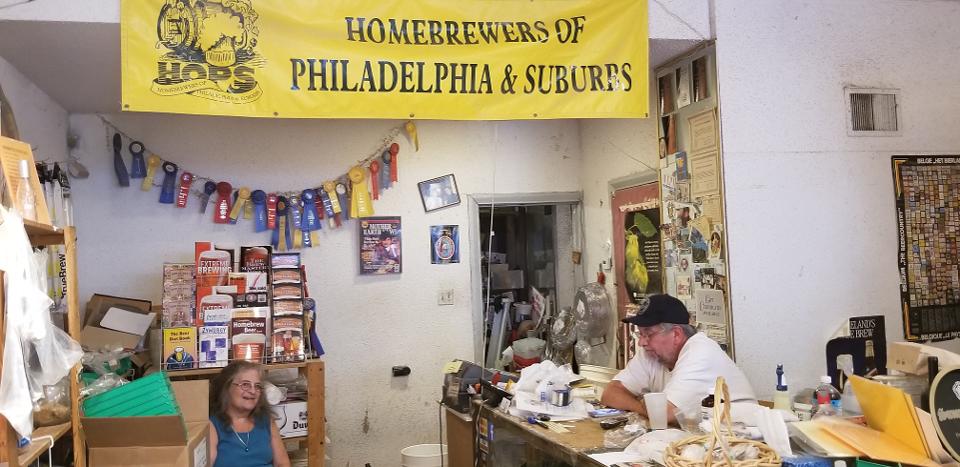
Nancy Rigberg expected to run her homebrew-supply storefront boutique until she turned 70. But at 63, she and her husband, George Hummel, have decided to take early semi-retirement and close down the existing brick-and-mortar part of Philadelphia’s oldest homebrew shop, Home Sweet Homebrew, which they’ve owned since the early 1990s.
“For one we’re getting old,” half-jokes Rigberg, who bought the store with Hummel from the original owners who’d opened it across the street in 1986.
“The real estate market has changed,” she says, more seriously, of her slice of Center City just west of trendy Rittenhouse Square. “If you’re not a restaurant or a dry cleaner or nail salon there’s very little room in the market for small retail.”
Hummel chimes in from behind the glass counter where he watches over the grain sacs, rubber hoses, vintage brewery t’s, moving boxes and the one person who enters the shop while I’m there at 4:30 on a Friday less than ten days before the shop closes for good — a delivery man looking for an address.
“$2 million condos are going up on the corner,” he says. “People spending that much aren’t coming home and making beer.”
But pricey highrises aren’t the only thing sapping the energy from Home Sweet Homebrew, which will shut down its sole location Labor Day weekend. As I wrote here in 2016, overall, the approximately $1 billion homebrewing business is taking some heavy hits; Fifteen-hundred miles away, Houston’s oldest shop, open since 1971, is closing September 8, citing slow sales.
“Homebrewing grew rapidly between 2006 and 2014. In that time frame our membership went from 9720 at the end of 2005 to 45,519 at the end of 2014. We’ve since stabilized between 45,000 and 47,000 members. During that time of rapid growth a lot of new shops opened up, likely creating some over supply of stores that couldn’t handle having the market level off,” emails Gary Glass, director of the AHA.
Even Anheuser-Busch InBev (AB InBev) got out of the industry: in July it sold the online powerhouseNorthern Brewer homebrew supply shop to a holding firm that describes itself as an entity that “rescues small- to mid-sized distressed companies” and “corporate orphans that are in out-of-favor industries or are undergoing some form of transition.” AB InBev’s “growth and innovation” arm, ZX Ventures, purchased Northern Brewer a mere three years ago.
“When there’s so much beer available why should you bother making it?” asks Hummel, summing up the main reason why I say, along with the departing owner of Houston’s DeFalco’s Home Wine & Beer Supplies and others, that homebrewing has largely become a victim of its own success.
Philadelphia, August 23, 2019 — Breweriana at Home Sweet Homebrew, Philadelphia’s oldest homebrew shop, which is closing Labor Day weekend.
TARA NURIN
Modern American homebrewing started around the 1960s and 70s, when domestic beer drinkers grew deeply unsatisfied by the pale adjunct lagers that dominated the marketplace. A large subset of influential early brewers like Jack McAuliffe and Ken Grossman developed their talents over homebrew set-ups before going on to found New Albion Brewing and Sierra Nevada Brewing, respectively. Since then, so many homebrewers have “grown up” to become commercial brewers that the Brewers Association trade lobbying group reports a record-setting 7,500 breweries operating across the U.S. as of June 30.
“While I think homebrewing in general is quite healthy and we likely have as many homebrewers now as we’ve ever had in this country, when a new brewery opens, it’s very likely that a local homebrew shop just lost one of their best customers. Many of the local shop’s customers will likely visit the new brewery as well,” writes Glass. “If those customers are spending more time at a new brewery, they are going to have less need to be stocked on their own homebrew.”
“Yards, Flying Fish, Victory, Oxbow, Sam (Calagione, of Dogfish Head),” list Rigberg and Hummel as they brainstorm some of the notable breweries and brewers that got their start buying homebrew supplies from them.
“The good memories are all the neat people we’ve met, the friends we’ve made,” muses Rigberg. “Everything has really changed.”
She’s not just being sentimental. So much has really changed, even in the past five-to-ten years. It’s not just rents that she says have climbed 20%-25% per year since Center City Philly started rebounding from economic gloom in the late 1990s, and it goes beyond the fact that a local craft beer drinker has only to go into almost any bar or bottle shop to browse an assortment that would have been impossible to imagine even a year ago.
To start, despite the explosion of breweries and their ensuing beer offerings, interest in beer is giving up ground to spirits, suggesting that the brew-your-own craze may be sputtering out as the number of people who wanted to make or drink better beer has plateaued. Second, online suppliers have crushed mom-and-pop retailers – especially those cramped into small, expensive downtown spaces like Home Sweet Homebrew — with their lack of overhead and unlimited storage space. Third, older operators like Rigberg and Hummel are reaching retirement age and growing tired of running a shop on such a barebones budget they no longer hire help.
But it’s also more than that. It has to do with the changing attitudes of the younger generations, and Rigberg and Hummel are just plain over it.
“People used to come in here because they wanted my knowledge and now they come in because they want to tell me why I’m wrong,” Hummel says.
Buried in their smart phones, customers don’t bother to say hello, Rigberg laments. They express their aggravation when the couple very occasionally closes for a few hours to attend a rock concert or family celebration, and they grumble when Hummel tells them he can order them ingredients or equipment that will take a few days to arrive. Rigberg calls it the “Amazoning of America.”
“This 24/7, ‘satisfy me now’ mentality is annoying,” she says. Reminiscing about the days when she and her husband built relationships with customers over decades, she says, “We’re trying to please everybody with everything without any kind of reciprocal loyalty.”
Philadelphia, August 23, 2019 — The outside of Home Sweet Homebrew, Philadelphia’s oldest homebrew shop, which is closing Labor Day weekend.
The 24/7 mentality also means everyone’s on and everyone’s chasing the next thing. All the time. Who wants to spend an entire day brewing two cases of an unsexy intro-level red ale in the driveway that you’ll tire of before you finish when instead you can line up for a bottle of limited-release maple bourbon chili stout that you can Instagram, brag about and trade?“It’s a clique thing too,” Rigberg says. “They don’t want to connect with the history.”
Hummel concludes in his endearingly curmudgeonly way that, “They don’t understand that in 1984 you couldn’t get anything but p**s in this town and some stale imports.”Though they won’t disclose their plans yet, the Home Sweet Homebrew pair says they’re working on a new project and will continue to order supplies for their customers and deliver them right to the door.That means ultimately, Rigberg might make it to 70 selling homebrew supplies. That’s more than the 66-year-old owner of the 48-year-old DeFalco’s can say, telling a longtime customer in front of a Houston Chronicle reporter, “We were hoping to make it to 50.”
I’m the beer and spirits contributor to Forbes — a freelancer who primarily covers lifestyle trends with a focus on craft beer, alcohol and culinary tourism and their impact on economic development. My writing has been published in Food + Wine, Wine Enthusiast, USA Today and many additional media outlets, which has won me 1st place awards in business writing and commentary from the North American Guild of Beer Writers; a 1st place business writing award from the NJ Society of Professional Journalists and the Food Writer of the Year designation in a competition hosted by the Wine School of Philadelphia. I co-founded Ferment Your Event to lead craft beer pairings and seminars (specialty is beer + chocolate), and I co-host a weekly radio show called “What’s on Tap” in addition to teaching the Craft of Beer course at Wilmington University. I volunteer as the archivist for the international Pink Boots Society for the advancement of women in beer and founded NJ’s original beer-education group for females. I’m an official beer judge, a Cicerone Certified Beer Server and an urban pioneer on the scenic Camden, NJ, waterfront. Please visit my website, www.taranurin.com.
Applicants are only asked to choose how many entries they wish to enter and pay for, and to identify the judging centers to which they’d be willing to ship entries. Beer registration styles and specialty information are required after the application window closes January 30, 2018.
Entry fee is $14 per entry in 2018.
Important Dates & Deadlines:
Application Window: January 23 through January 30, 2018
Entry Registration & Payment: Notification February 5 through February 15, 2018.Applicants will then have 72 hours from the date of notification to pay for their entries.
Judging/Stewarding Signup: February 8, 2018
First Round Shipping Window: March 19 through March 30, 2018
First Round Judging (all sites): April 6 through April 22, 2018
* * *
American Homebrewers Association Competition Coordinator John Moorhead is director of the National Homebrew Competition, coordinates the Great American Beer Festival® Pro-Am Competition and the Capitol Hill Staff Homebrew Competition, works on homebrewing legislative issues, and writes for HomebrewersAssociation.org.
All good dessert recipes deserve a good story. Surely you’ve got a memory you can dig up somewhere of baking your grandma’s sacred family cookie recipe or the first time you properly executed that pineapple upside down cake (Bravo!).
The same goes for Charlie Papazian’s fondness for pies. Before he started spreading the love of homebrewing and independent beer, Papazian spent his career teaching kindergartners how to sound out the alphabet and identify shapes and colors (he has always loved to teach and share his knowledge, after all).
Many years ago on his birthday—January 23—he asked his tiny students to request that their parents make and bring pies for a birthday celebration and, lo and behold, dozens of pies showed up. He was impressed. So impressed, in fact, that he ended up starting the Great American Pie Festival and the Great American Pie Competition in Boulder, Colo. His love for pies even went a step further when he submitted January 23 as National Pie Day to Chase’s Calendar of National Events in the late 1970s.
This pie is one of his classic pie recipes that pulls its sweetness from fruit and honey rather than sugar. After judging many pies, Charlie began to see the value in natural sweetness. Enjoy!
Blueberry Pie
Ingredients:
For the filling:
enough fresh or frozen blueberries to fill the pie plate, about 2–3 cups
2 Tbsp. salted butter, cut into small pieces to evenly distribute
1–2 Tbsp. flour
2–3 Tbsp. honey or maple syrup
½ tsp. cinnamon
½ tsp. fresh-ground coriander seed
¼ tsp. fresh-grated nutmeg
2 Tbsp. fresh-squeezed lemon juice
For the pie crust:
2 cups wheat flour
pinch of salt
2/3 cup butter
5–7 Tbsp. cold water
Directions:
Step 1: Preheat oven to 425° F while you prep your dough and filling.
Step 2: Put flour, water, and about half of your butter into a food processor and pulse a few times. Add the rest of the butter and pulse about 6–7 more times. Take ice-cold water (without ice cubes) and add 5–7 tablespoons evenly to the mixture. Pulse again until the dough just barely holds together. Empty the dough mixture onto a clean, dry, flat surface. Do not knead the dough: this makes it tough, which is not ideal for pastry dough. Instead, roll the dough into one big mound and then split it into two separate mounds. Wrap the dough mounds in plastic wrap and place in the refrigerator for 1–12 hours.
Step 3: After you’ve allowed the dough to rest, take it out of the refrigerator and let it warm up for 5–10 minutes. Sprinkle some flour on a surface so that you can roll one of the mounds out into a 12-inch circle about 1/8 inch thick. Take the rolled-out flour and line a 9″ pie pan. Pinch the flour down around the sides of the pan to make a crust.
Step 4: Stir the blueberries, honey, salted butter (in pieces, evenly distributed), flour, cinnamon, coriander, nutmeg, and lemon juice together in a mixing bowl. Add to the shell crust.
Step 5: Roll out the other mound of dough the same way that you prepared the shell crust. Lay over the top of the berries and pinch crusts together to seal along the edges. Use a bit of aluminum foil to wrap around the edges of the pinch crust so they don’t burn in the oven.
Step 6: Bake in the oven at 425°F for 25–30 minutes on the bottom rack. Move to the upper rack for another 25–30 minutes at a reduced heat of 350–375°F.
Pairing Suggestions
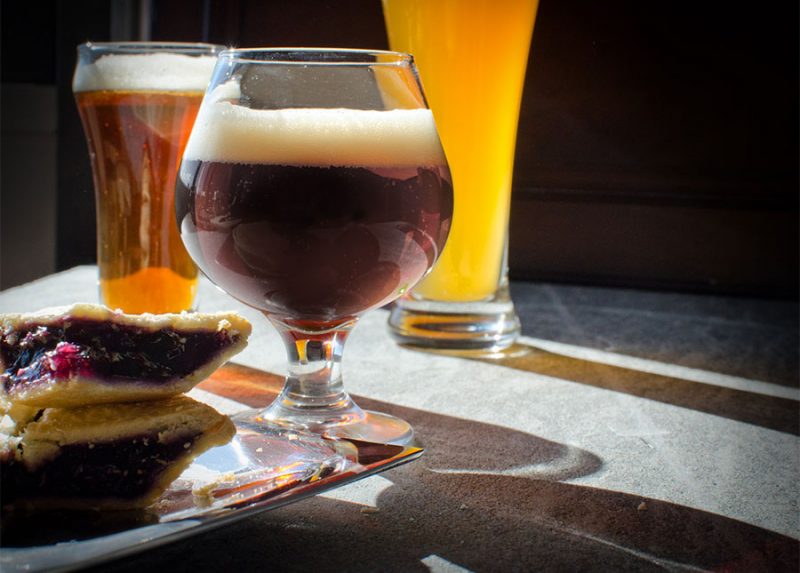
An English brown ale is simultaneously simple and complex in flavor, much like a classic blueberry pie. The tart sweetness from caramelized blueberries is a great complement to the subtle bitterness in an English brown. We all know there is nothing quite like a perfectly baked pie crust, which in this case pairs particularly well with the malty sweetness of the brown ale.
English Brown Ale Homebrew Recipe
If you’re planning ahead, brew this English brown ale featured in The Homebrewer’s Companion by Charlie Papazian.
Specs:
Original Gravity: 1.068–1.072
ABV: 6.5%
IBU: 38
SRM: 25–30
Ingredients for 5 gallons (19 L):
5 lb. (2.3 kg) American two-row lager malt
3 lb. (1.36 kg) Munich malt
2 lb. (0.9 kg) Vienna malt
1.5 lb. (0.68 kg) crystal/caramel malt 40°L
0.25 lb. (113 g) chocolate malt
1 oz. (28 g) Fuggle hops, 4% a.a. (boiling)
0.9 oz. (21 g) Williamette hops, 4.5% a.a. (boiling)
0.35 oz. (10 g) Cascade hops, 7% a.a. (flavor)
0.35 oz. (10 g) Cascade hops, 7% a.a. (aroma)
1/4 tsp. (1 g) Irish moss
ale yeast
3/4 cup (178 mL) corn sugar or 1.25 cup (296 mL) dried malt extract for bottling
Directions:
Using a protein-developing step mash, add 3 gallons (11.4 L) of 130°F (54°C) water to the crushed malt. Stabilize at 122°F (50°C) and hold for 30 minutes. Then add 1.5 gallons (5.7 L) of boiling water. Stabilize at 148–150°F (64–66°C) and hold for 60 minutes. Add heat and mash out to 165°F (74°C).
Sparge with about 3–4 gallons (11.4–15.2 L) of 170°F (77°C) water. Add more water (do not over-sparge) to brew pot to make an initial extract volume of 6.5 gallons (24.7 L) Anticipate evaporation of slightly more than 1 gallon (3.8 L). Add boiling hops and boil for 75 minutes. Then add flavor hops and Irish moss and boil for an additional 15 minutes. Total boiling time is 90 minutes. Turn off heat. Add aroma hops and let steep for 2–3 minutes before removing hops and chilling the hot wort.
* * *
Hailing from the South, Millie Shamburger has developed an affinity for the beer industry and all the shiny things that come with it. When not exploring beer, Millie is in the kitchen, enjoying the outdoors, and wearing out her dancing shoes.
Father of homebrewing, founder and innovator to leave lasting legacy after 40 years.
Boulder, CO • January 23, 2018—The Brewers Association (BA)—the not-for-profit trade group dedicated to promoting and protecting America’s small and independent craft brewers—today announced that founder and past president Charlie Papazian will exit the Brewers Association on January 23, 2019, marking his 70th birthday and 40 years building the craft brewing community and inspiring brewers and beer lovers around the world.
“We are all here today because of Charlie Papazian,” said Bob Pease, president and CEO, Brewers Association. “His influence on the homebrewing and craft brewing community is immeasurable. Who could have predicted that a simple wooden spoon, ingenuity and passion would spawn a community of more than one million homebrewers and 6,000 small and independent U.S. craft breweries.”
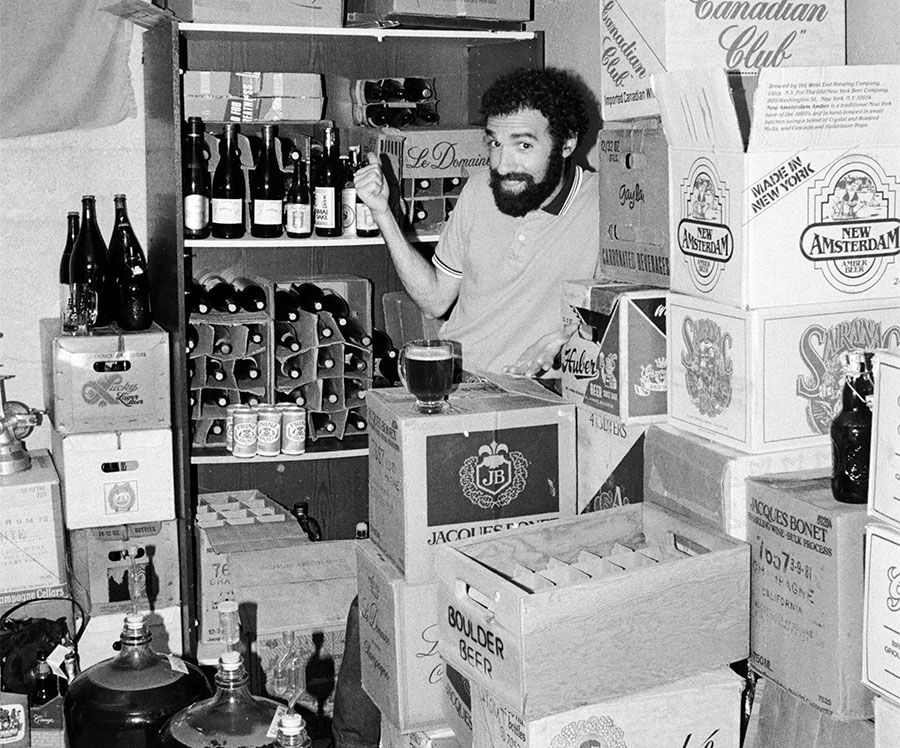
Charlie in his beer cellar circa 1985.
Charlie Papazian, founder of the American Homebrewers Association (AHA) and the Association of Brewers, set the stage for homebrewing back in the 1970s. His expertise and friendly tone assured people that making good beer was possible at home. He stressed his catchphrase of “Relax. Don’t worry. Have a homebrew” in his first book, The Complete Joy of Homebrewing and inspired millions to pick up the hobby of homebrewing.
Papazian (L), along with Charlie Matzen, formed the AHA in Boulder, CO.
In 1978, Papazian, along with Charlie Matzen, formed the AHA in Boulder, CO. They published the first issue of Zymurgy magazine, announcing the new organization, publicizing the federal legalization of homebrewing and calling for entries in the first AHA National Homebrew Competition. Today, the AHA is more than 46,000 members strong.
In 1982, Papazian debuted the Great American Beer Festival (GABF) in Boulder, CO. Now in its 37th year, GABF is the largest ticketed beer festival in North America with more than 60,000 attendees annually and its accompanying competition is one of the most coveted awards in the brewing industry.
The following year, the Association of Brewers was organized to include the AHA and the Institute for Brewing and Fermentation Studies to assist the emerging microbrewery movement in US. By 2005, the Association of Brewers and the Brewers’ Association of America merged to form the Brewers Association.
Charlie revisiting the spot in Charlottesville, Virginia where he brewed his first batch of beer in 1970. Photo was taken in 1979.
When asked, “Charlie, did you ever imagine that beer would become this?” His answer is always yes.
“I had a playful vision that there would be a homebrewer in every neighborhood and a brewery in every town. But what I did not imagine, couldn’t imagine, never considered, was the impact that craft brewing would have on our culture, economy and American life,” mused Papazian.
Papazian will spend his final year at the BA completing many projects, including a craft brewing history archive project. The archive will house 40 years of craft beer history in the form of more than 100,000 publications, photographs, audiotapes, films, videos, and documents—including 140 video interviews of the pioneers of American craft brewing—and will be accessible to researchers via the BA. He will also deliver the keynote address at the AHA’s 40th annual National Homebrew Conference, “Hombrew Con,” in Portland, OR on Thursday, June 28.
Brewers and homebrewers are invited to share their well wishes and Charlie Papazian stories on the AHA and BA Facebook pages.
The International Herb Association (IHA) has selected the 2018 Herb of the Year, and it is our favorite bitter beer ingredient: hops!
Established in 1991, the IHA annually recognizes an herb to educate its members and the general public about. The IHA’s website explains that its Horticultural Committee evaluates possible choices based on the herb’s being outstanding in at least two of three major categories: medicinal, culinary, and decorative. In 2017, coriander—also a common ingredient in Belgian-style beers—and cilantro, edible products of the same plant, collectively earned the Herb of the Year title.
Visit iherb.org for more information on the International Herb Assocation’s Herb of the Year award. If you want to cultivate your own hops at home, visit our guide to growing hops!
John Moorhead, the competition coordinator at the American Homebrewers Association, joined the Out Here Having a Pint crew for episode 1 of their beer podcast.