Posted on

An Overview of Revenue and Expenses for Homebrew Clubs

By Chris P. Frey,  Ann Arbor Brewers Guild & AHA Governing Committee member

Club funds allow homebrew clubs to support a variety of activities. A club’s priorities depend on whether the club is just starting or long-established. One of the most entrusted positions within a club is that of club treasurer, for which careful tracking of all expenses and revenues is essential.

Because many homebrew clubs are relatively small, the first challenge for many clubs is finding an appropriate financial institution that will set up an account in the club’s name. Many banks will not do this. Credit unions can be more flexible, but if all else fails, a checking account can usually be opened in both the club treasurer’s and president’s names. As members vote for new officers, this typically requires all names on the account (old and new) to visit the depository institution to meet and sign off on the changes. While logistically challenging, the value of a simple checking account for a club can’t be overstated, as it allows a great deal of flexibility and accountability.

Let’s now turn to common revenue and expense sources for homebrew clubs.

Dues

The primary source for many club’s revenue is membership dues, which members usually pay annually. Clubs can also pro-rate dues. In one of the clubs where I am currently the treasurer (Ann Arbor Brewers Guild – AABG), dues are $15 a year. This equals $1.25 a month, so if a new member joins during the year, it is easy to determine what they owe. However, for members who delay renewing (say in March for the year), we continue to ask them for the full year’s dues.

Additionally, over the years, we have developed different classes of membership.

  • Family membership: For $20 a year, a family membership has been offered because many members’ spouses, roommates, and/or significant others didn’t actively participate in the monthly meetings, but wanted to join a club’s annual barbecue or obtain separate local homebrew supply discount cards (a member benefit) so that they could purchase gifts with the club discount for their friends or partners.
  • Discounted long-term membership – We developed this membership level for members who wished to pay for several years in advance. While the discount is small ($40 for 3 years for an individual membership, $50 for a 3-year family membership), it provides members the option to prepay, save a little money, and beef up the clubs treasury. I have learned two important lessons about money: 1. More is better than less, and 2. Now is better than later!
  • Out-of-state membership – The AABG has been around since 1986, and the club’s email distribution list is an important channels for members to stay in touch, so several members who have moved out of state have requested to stay members. For these members, we created this form of discounted membership, which is $15 for three years or $50 for life.
  • Non-paying members – We allow people to request to be on the email distribution list, but until they are a member in good standing, they can only receive the club emails and cannot post to the distribution list.
  • Free membership – We have developed two free memberships.
    • The first is for exceptional service to the club or the homebrewing community: honored guests, competition organizers, whatever is deemed appropriate.
    • The second is for members who have fallen into hard times, such as losing their jobs. Because of the sensitivity of the later class, members just have to attest to the treasurer that this is the case. They can elect to pay back dues when they get back onto their feet again or not. The idea is that after one loses their job, it would be adding insult to injury if they had to prioritize other more basic necessities and lose the camaraderie and friendship of the club.

And here is a tip to encourage members to pay their dues. A day or two before each club meeting, the treasurer sends out a note through the club email distribution list. I simply title mine “The Good List.” Almost every month I receive stragglers’ dues this way.  And we also accept PayPal and simply add the transaction fee to the amount.

Sell AHA Memberships

The American Homebrewers Association’s web banner program allows homebrew clubs to generate revenue for themselves by encouraging their members to join the AHA through a custom hyperlink. For every person who joins through that link, the AHA will mail the club a rebate check on a quarterly basis. To sign up for the web banner program, or to find out more information, visit the Generate Revenue page on Club Connection.

Merchandise Sales

Anyone who has attended local beer festivals, taken part in Homebrew Con, or just walked into a local brewpub has probably spied someone wearing an article of clothing with a homebrew club logo on it. Virtually all homebrewing clubs come up with a name and a logo, and attaching these to a variety of items acts both as a source of pride and a form of marketing for the club. Selling these items to club members should also be a source of revenue.

The most popular logo’ed merchandise item is the club shirt. T-shirts and polos are great ways for members to display their club affiliation. Hats, children’s clothing, and infant-wear are other possibilities.

Additionally, tasting glasses engraved with the club logo (and perhaps 1- and 2-ounce pour lines) are a great way to encourage moderation and show off the club logo. Business cards with the club’s logo, website, and meeting information can also work terrifically in generating leads from current members.

These are some of the most common merchandise items. Clubs typically round up in $5 increments based on the costs. Shirts can be a difficult proposition for a fledgling club, as the discounts usually occur around the two- or three-dozen mark. Getting pre-order commitments is the best way to go so that the club treasury can bear the upfront purchase, but then reap some dividends at subsequent meetings as the shirts are sold off. It is usually a good idea to order some extras as well for future members,

Host a Competition

If the club has the inertia and resources (both in up-front funds and access to certified beer judges), a competition is not only a great fund raiser, but allows for a group activity that is rewarding on multiple levels. It can take a couple of years to generate the number of entries necessary to break even and then earn some funds, but it also allows members to participate in judging, stewarding, and pre-events such as calibrating their expectations.

50/50 Raffles

An easy way to supplement the club’s coffiers is to purchase a roll of raffle tickets and sell these at the meeting. A dollar apiece, six for $5 allows members to participate in a game of chance whereby they can win half the pot, and the club earns the other half. Please make sure that you review your local regulations regarding this activity to ensure compliance with the law.

Silent Auctions

A great way for members to get rid of their unwanted equipment or excess ingredients, a silent auction can also be held in junction with a club event such as a beer-becue or holiday party. A member asks their local homebrew supplier to see if they have any items that they are willing to donate to the cause. Simply place the available items on a table with a signup sheet for each one, and members can add their names and see which bid holds until the end.

Events

Most clubs host a variety of events. These can be annual beer-becues, holiday parties, brewing demonstrations, Big Brew day celebrations, pub crawls, and other events. Food is typically served at such events, and decorations, prizes, and other expenses can be incurred. It is up to each club to determine if these events will be gratis for paid-up members, or if they want to defray some or all of the expenses with an event fee. The obvious benefit of doing so is to offset some or all of the event’s expenses.

Expenses

Once the club has some funds, what are you going to spend them on? The wish list can be expanded ad infinitum, so I will only mention some of the better known expenditures that I have run into in my dealing with some local clubs.

  • All-grain system for club rental
  • Jockey box
  • Pop-up tent
  • Brewing-related book titles for a club library
  • Counter-pressure bottle filler
  • Shirts, hats, and other logo items for sale
  • Club banner for events
  • Business cards promoting the club
  • Club meeting space rental
  • Events
  • Thank-you gifts
  • Plaques and trophies for club competitions
  • Commercial examples of beer styles for calibration and educational purposes
  • Off-flavor sensory sampling supplies
  • Entry fees and postage for club-only competitions
  • Membership to a beer-of-the-month club
  • Flowers and gifts for members in good standing who suffer a loss
  • Name tags for meetings
  • Water bottles for demonstrations
  • Lamination device for ID Cards
  • Card stock
  • Club bar
  • Supporting local and state homebrew competition as a sponsor
  • Breathalyzer
  • Offset members entrance fee to a Homebrew Con
  • Port-a-potty for events
  • Postage for snail mail newsletters, club-only competitions, etc.

If you have any questions or suggestions, please contact the AHA Club Support Subcommittee.

The post An Overview of Revenue and Expenses for Homebrew Clubs appeared first on American Homebrewers Association.

Posted on

Cherry Dubbel

Conduct a mini-mash in a 3-gallon (11.4 L) stock pot using a 5-gallon (18.9 L) nylon mesh paint strainer bag from the hardware/paint store. Crush the grain and put it in the mesh bag. Heat 6 qt. (5.7 L) water to 165°F (74°C) (a ratio of 2 qt./lb. or 4.2 L/kg), and immerse the grain bag. Make sure all the grain is thoroughly wetted quickly and check the temperature.

The mash temperature of the grain and water should now be about 150–155°F (66–68°C). Let mash sit for a half hour. Add heat while stirring to raise the temperature to 155°F (68°C) and let mash sit for another half hour. Place 2 gallons (7.6 L) water in a 5-gallon (18.9 L) boiling pot and heat to 165°F (74°C). Lift bag out of the first pot and let it drain for a minute before transferring to another pot. Swirl the bag in the pot to re-wet the grain and let it sit for 5 minutes. Lift the grain bag, drain, and discard the spent grain.

Add the wort from the first pot and the 3.3 lb. (1.49 kg) of liquid light malt extract to the second pot, and begin your boil. Wait for the hot break to occur, and then add the hops. Boil for 60 minutes. Add the remaining 3.3. lb. (1.49 kg) of liquid amber malt extract and the dark candi syrup during the last 10 minutes of the boil. Stir to prevent scorching. Chill the wort and dilute in the fermenter to 5 gallons (18.9 L). Pitch 2–3 vials or packs or White Labs WLP500 for a good pitching rate, and aerate thoroughly. Add the cherry juice concentrate after the third of fourth day of fermentation after activity has slowed.

The post Cherry Dubbel appeared first on American Homebrewers Association.

Posted on

Brew & Bites: Homemade Beer BBQ Sauce

Ditch the shopping list and head to your local market! There’s no better way to discover ingredients that could lead you down an unexpected path to a far out beer recipe, a delicious dish, or the perfect pairing.

Well, I guess the old saying is right—the early bird really does get the worm! Recently, I stopped by my local farmers market early one morning and stumbled upon an impressive rack of ribs. “Last one of the day,” the man behind the table said with a smile. That was enough motivation to have him wrap it up and stick it in my purse.

I planned on my usual process for preparing ribs—covering the rack in my favorite dry rub, broiling for about 5 minutes, and then cooking for 2 hours at 300°F—but I wanted to try something a little different, too. That’s when I stumbled on this beer BBQ sauce, which calls for a bottle of your favorite malt-forward brew!

Simple Beer BBQ Sauce Recipe

This recipe is by Steve Denny and was originally published on CraftBeer.com. The recipe calls for 12 oz. (355 mL) of bock-style beer, but you can substitute in your favorite malt-forward beer instead. I went with a homebrewed Belgian-style dubbel!

Ingredients:

  • 2 cups (473 mL) ketchup
  • 3 Tbsp. (44 mL) chili powder
  • 12 oz. (355 mL) bock, or other malty beer
  • 1 tsp. (5 mL) smoked paprika
  • 1 Tbsp. (15 mL) regular paprika
  • 1 Tbsp. (15 mL) garlic powder
  • 2 Tbsp. (30 mL) yellow mustard
  • 1/2 tsp. (2–3 mL) cayenne pepper (add more if you want more kick)
  • 2 Tbsp. (30 mL) brown sugar, packed
  • 2 Tbsp. (30 mL) molasses
  • 2 Tbsp. (30 mL) apple cider vinegar

Directions:

Prep time: 5 minutes

  1. Whisk all ingredients in a sauce pan and turn heat to medium, bringing sauce to a slow boil.
  2. Reduce heat and simmer for 20 minutes.
  3. Serve with your favorite BBQ.

Pairing Suggestions

When pairing with ribs and a rich BBQ sauce, malt-forward beer is the name of the game. I decided to go with the same strong and complex Belgian-style dubbel that I used in the BBQ sauce recipe. The intensity of the pork fat will most definitely stand up against the strong characteristics of the dubbel, while the malty sweetness in the BBQ sauce creates a perfect, porky pairing.

Belgian-Style Dubbel Homebrew Recipe

If you’re planning ahead, brew this Belgian-style dubbel (recipe by Sean Paxton, Home Brew Chef) to use in the BBQ sauce recipe and to pair with your rack of ribs.

Specifications:

  • Recipe Source: Dubbel Your Pleasure
  • Original Gravity: 1.072
  • Final Gravity: 1.014
  • ABV: 6%
  • IBU: 25
  • SRM: 22.5
  • Boil Time: 90 minutes
  • Efficiency: 75%

Ingredients for 6 gallons:

  • 5 lb. (2.3 kg) Belgian Pilsner (two-row) malt
  • 2.5 lb. (1.1 kg) Maris Otter pale malt
  • 1.5 lb. (680 g) CaraMunich malt
  • 1.5 lb. (680 g) CaraVienne malt
  • 0.5 lb. (227 g) aromatic malt
  • 0.5 lb. (227 g) Belgian wheat malt
  • 0.25 lb. (113 g) Special B malt
  • 1 oz. (28 g) East Kent Goldings (60 min)
  • 1 oz. (28 g) Hallertauer Hersbrucker (30 min)
  • 1 oz. (28 g) Styrian Goldings (15 min)
  • 2 lb. (907 g) Turbinado sugar (90 min)
  • 1 lb. (454 g) D2 syrup (15 min)
  • Wyeast 3787 Trappist High Gravity Yeast (starter)

Directions:

Step infusion mash starting at 95°F (35°C). Dough in for 15 minutes, raise to 122°F (50°C) for 15 minutes, then to 135°F (57°C) for 15 minutes. Saccharification rest at 148°F (64°C) for 120 minutes. Mash out at 165°F (74°C) for 15 minutes, then sparge with 170°F (77°C) water. Boil for 90 minutes.

Pitch yeast at 64°F (18°C) and let temperature rise to 74°F (23°C) over six days. Transfer to secondary and let sit for 14 days. Keg or bottle condition.

The post Brew & Bites: Homemade Beer BBQ Sauce appeared first on American Homebrewers Association.

Posted on

1.1 Million Americans Homebrew Their Own Beer

[This press release was originally published on BrewersAssociation.org]

According to newly released demographics data from the American Homebrewers Association (AHA)—the leading organization dedicated to advancing and educating people on the hobby of homebrewing—there are currently 1.1 million people in the United States who homebrew their own beer, and 40% of them started the hobby within the last four years.

“Homebrewing, in our opinion, is the greatest hobby there is, and the state of the hobby—underscored by homebrewers’ passion, commitment and creativity—is strong,” said Gary Glass, director, American Homebrewers Association. “The numbers show that we have a lot to look forward to in the years ahead, as the hobby is evolving and expanding, reaching Americans in every region and every corner of the country.”

View Infographic

Additional highlights from the AHA’s recent survey include:

  • By the end of 2017, homebrewers will have produced more than 1.4 million barrels of brew—representing 1% of total U.S. production.
  • Homebrewers are spread across the country, with 31% in the South, 26% in the Midwest, 24% in the Northeast and 19% in the West.
  • The average homebrewer is 42 years old, and 52% are between ages 30-49.
  • Eighty-five percent are married or in a domestic partnership.
  • Sixty-eight percent have a college degree or some form of higher education, and nearly 68% have household incomes of $75,000 or more.

About the survey:

The AHA commissioned 1st Resource, a market research firm, to conduct the online survey from July 21 to September 22, with over 18,000 participants, consisting of both AHA and non-AHA affiliated individuals.

The post 1.1 Million Americans Homebrew Their Own Beer appeared first on American Homebrewers Association.

Posted on

What to Age in Your Beer Cellar

Cellaring is the process of allowing a beer to mature under specific conditions to achieve nuances, particularly in its flavor and aroma, that often can only be achieved with aging. What you’re left with after aging beer successfully is what is called “vintage beer.”

Choosing a Beer Cellar Location

Before jumping into some tips on what makes a beer optimal to age (because not all of them are!), it is important to understand the beer cellar environment that is ideal for aging beer for an extended time.

1. Temperature

Arguably the most important aspect of a beer cellar is the temperature. 55°F (12.8°C) has become a widely accepted temperature for aging most ales. Lagers aren’t usual suspects for cellaring, but a good rule to follow is to aim to keep beer cellar temperatures about 10°F below the temperature at which the beer is fermented.

Generally, ales are fermented around 65°F (18.3°C) and lagers at 50°F (10°C). Being able to maintain a temperature in this range with little fluctuation will allow the beer to mature at an appropriate rate. If it’s too cold, the maturation period slows significantly, and if too warm it can speed things up and cause off-flavors.

2. Darkness

The second thing to keep in mind is light. Keep your cellar dark! UV light interacts with hops in beer to create the dreaded light-struck flavor, otherwise known as “skunked” beer. Keep your beers shielded from light in any way possible, especially if they are packaged in clear or green bottles. A cheap way to prevent light-struck beer is to stick them in a sealed box or paper bag.

Those are the basics, but the trickiest part for cellaring is deciding which beers are suitable for aging because, after all, some just aren’t up for the task.

Tips for Picking a Beers to Cellar

1. The more alcohol, the better

When aging beer, it is crucial that there is a preservative present, which will essentially slow the aging process. A good rule of thumb is to aim for a beer that has at least 8% alcohol by volume (ABV). You may think speeding up the aging process is desirable, but in the case of cellaring beer the best technique is a slow-and-steady approach. A preservative like alcohol makes beer more resilient to potential staling flavors, which are typically caused by oxidation. And keep in mind that the booziness that is often present in fresh beers with high ABVs will typically mellow over time, allowing other flavors to come to the forefront.

All of that being said, there are some exceptions to the “more alcohol, the better” rule. The lactic acid in sour beers and the smokey phenols in smoked beers also act as preservatives, lessening the importance of the level of alcohol.

2. Body by beer cellar

During the aging process, the malt proteins present in beer will drop out. This reaction causes the body of beer to reduce over time, and the result is often a very thin and some cases overly-dry beer after it’s been aged. Wheat-derived proteins tend to fall out exceptionally quick, making wheat-based styles very tricky to age successfully. Because of this, it is important to cellar beers that are very full-bodied when they are fresh. This allows the malt proteins to drop out while still retaining some of the body and overall balance.

If a beer seems to thicken, becoming almost syrupy over time instead of thinning, it most likely means the alcohol character has decreased (as mentioned in #1) to the point where it creates the impression that the body thickened.

Esters-Phenols-Homebrew-slider

3. Mind your esters and phenols

The yeast-derived character of both esters and phenols will evolve and change over time, which may or may not be desirable depending on the base style of the beer.

The fruity esters—reminiscent of pears and other tree fruits—commonly found in Belgian and some British style ales will develop into more dark fruit-like character (think raisin and figs). Banana esters, like those common in German hefeweizens, tend to disappear altogether in a fairly short span of time. Esters from Brett will take much longer period of times to change, but have the potential to achieve interesting flavors like pineapple and grapefruit.

Phenols—the spicy yeast flavors that come across as clove or pepper—will evolve into much different flavors, including vanilla, tobacco and leather. In instances where earthy phenolics are present in the fresh beer, there is the potential to achieve complex flavors that are all but impossible to achieve unless done with aging.

4. More hops isn’t always best

Remember when we said beer needs some sort of preservative to be a good candidate for cellaring? Well, despite hops reputation as being originally used for its antibacterial utility, hop bitterness and flavor/aroma are not well suited for aging. Simply put, the presence of hops fades over time, and this can drastically affect the balance of a beer. After all, if a hoppy beer style like IPA was brewed to a desirable balance of malt and hops, then reducing the presence of hops can throw this harmony out of wack.

In some instances hop character not only diminishes but can result in unfavorable flavors left behind. For example, American hop varieties with high levels of alpha acids can leave behind stale, paper-like flavors. On the other hand, English hop varieties with high beta acids, which are said to have a better chance of retaining bitterness, can impart fruity notes similar to pineapple and cherry as they age.

how-to-grow-hops-slider

5. Sours

Sours can be a tricky beast when aging, and the results may not be what you expect. First off, the tart, lip-puckering character that puts the “sour” in “sour beer” will lessen with time, diminishing that typically-dominant characteristic. This softening of the sourness can be either a good or bad thing depending on the balance of the cellared beer at the time it’s consumed.

It’s important to note that while the sour character mellows and in some instances evolves (as with Brettanomyces) at a very, very slow rate, it is not uncommon for some sour beers to become even more sour in the first few years it’s being aged. It’s also not unusual for sour beers that have been aged for extended periods of time to appear more sour due to other characters, particularly the malt, diminishing.

Brett (short for Brettanomyces), though slow to evolve in the cellar, can undergo very drastic evolution when aged. Brett is a slow-acting yeast but a hungry one, and it will basically eat through all available fermentable sugars slowly but surely. This means extensive aging can often leave Brett beers bone dry, which can throw off the balance. During this process, the esters can evolve as mentioned in #3, but there is also the potential for aggressive phenolics to develop, which can be undesirable.

6. Keep the yeast in the bottle

Beers that are bottle conditioned, unfiltered and/or unpasteurized are generally better-suited for aging. By having yeast in the bottle, the beer is essentially a living entity that can consume residual oxygen and continue to condition slowly. This opens up a wider possibility of aging produced cellar character that a beer without yeast otherwise might not be able to achieve.

Filtered and/or pasteurized beers can still exhibit character evolution from aging but to a much lesser extent.


Sources: This post is based on the 2015 National Homebrewers Conference seminar “Crafting Cellarworthy Homebrew” presented by Patrick Dawson, author of Vintage Beer: A Taster’s Guide to Brews That Improve over Time. Download the audio/visual presentation of “Crafting Cellarworthy Homebrew.”


The post What to Age in Your Beer Cellar appeared first on American Homebrewers Association.
Posted on

2018 National Homebrew Competition Styles

The National Homebrew Competition (NHC) styles are determined by the AHA Competition Subcommittee using the Beer Judge Certification Program’s 2015 Style Guidelines and previous years’ data. The following is a list of BJCP subcategories reorganized from the BJCP’s 2015 Guidelines into NHC Styles. NHC Styles are listed in bold, while BJCP subcategories falling within NHC styles are listed beneath.

Entries entered in the following 2015 Beer Judge Certification Program (BJCP) subcategories will require specialty information and instructions: 7C, 9A, 10C, 21B, 23F, 24C, 25B, 27J, 28A, 28B, 28C, 29A, 29B, 29C, 30A, 30B, 30C, 31A, 31B, 32A, 32B, 33A, 33B, 34A, 34B, 34C, 35A, 35B, 35C, 36A, 36B, 36C, 36D, 36E, 37A, 37B, 38A, 38B, 38C, 39A, 39B, 39C, 39D, 39E, 40A, 40B, 40C, 40D, 40E, 40F.

*Special Ingredients Required


Pale American Beer

1A.   American Light Lager

1B.   American Lager

1C.   Cream Ale

1D.   American Wheat Beer

18A. Blonde Ale

Pale European Beer

2A.   International Pale Lager

4A.   Munich Helles

5A.   German Leichtbier

5B.    Kölsch

5C.   German Helles Exportbier

Pilsner

3A.   Czech Pale Lager

3B.   Czech Premium Pale Lager

5D.   German Pils

27F.  Pre-Prohibition Lager

Amber European Beer

2B.   International Amber Lager

3C.   Czech Amber Lager

6A.   Märzen

7A.   Vienna Lager

7B.   Altbier

7C.   Kellerbier*

Dark European Lager

2C. International Dark Lager

3D.   Czech Dark Lager

8A.   Munich Dunkel

8B.   Schwarzbier

Bock

4C.   Helles Bock

6C.   Dunkles Bock

9A.   Doppelbock*

9B.   Eisbock

9C.   Baltic Porter

German Wheat Beer

10A.  Weissbier

10B.  Dunkles Weissbier

10C.  Weizenbock*

27H.  Roggenbier

27I.    Sahti

Pale British Ale

11A. Ordinary Bitter

11B.  Best Bitter

11C.  Strong Bitter

12A.  British Golden Ale

12B.  Australian Sparkling Ale

12C.  English IPA

Scottish & Irish Ale

14A.  Scottish Light

14B.  Scottish Heavy

14C.  Scottish Export

15A.  Irish Red Ale

American Pale Ale (18B)

Amber & Brown American Ale

19A.  American Amber Ale

19B.  California Common

19C.  American Brown Ale

27B.  Kentucky Common

Brown British Beer

13A.  Dark Mild

13B.  British Brown Ale

13C.  English Porter

27D.  London Brown Ale

British & Irish Stout

15B.  Irish Stout

15C.  Irish Extra Stout

16A.  Sweet Stout

16B.  Oatmeal Stout

16C.  Tropical Stout

16D.  Foreign Extra Stout

American Porter & Stout

20A.  American Porter

20B.  American Stout

27G.  Pre-Prohibition Porter

Imperial Stout (20C)

American IPA (21A)

Specialty IPA (all)* (21B)

Strong American Ale

22A.  Double IPA

22B.  American Strong Ale

22C.  American Barleywine

22D.  Wheatwine

Strong UK Ale

17A.  English Strong Ale

17B.  Old Ale

17C.  Wee Heavy

17D.  English Barleywine

Saison (25B)*

Belgian Ale

24A.  Witbier

24B.  Belgian Pale Ale

24C.  Biere de Garde*

25A.  Belgian Blond Ale

26A.  Trappist Single

34A.  Clone Beer (Belgian Styles)

Strong Belgian Ale

25C.  Belgian Golden Strong Ale

26B.  Belgian Dubbel

26C.  Belgian Tripel

26D.  Belgian Dark Strong Ale

European Sour Ale

23A.  Berliner Weisse

23B.  Flanders Red Ale

23C.  Oud Bruin

23D.  Lambic

23E.  Gueuze

23F.  Fruit Lambic*

27A.  Historical: Gose

Fruit Beer

29A.  Fruit Beer*

29B.  Fruit and Spice Beer*

29C.  Specialty Fruit Beer*

Spiced Beer

30A.  Spice, Herb, or Vegetable Beer*

30B.  Autumn Seasonal Beer*

30C.  Winter Seasonal Beer*

Smoke-Flavored & Wood-Aged Beer

6B.   Rauchbier

27C. Lichtenhainer

27E.  Piwo Grodziskie

32A.  Classic Style Smoked Beer*

32B.  Specialty Smoked Beer*

33A.  Wood-Aged Beer*

33B.  Specialty Wood-Aged*

American Wild Ale

28A.  Brett Beer*

28B.  Mixed Ferm. Sour Beer*

28C.  Soured Fruit Beer*

Specialty Beer

31A.  Alternative Grain Beer*

31B.  Alternative Sugar Beer*

34D.  Clone Beer (non-Belgian)*

34B.  Mixed-Style Beer*

34C.  Experimental Beer*

27J.   Other Historical Beer*

Traditional Mead

35A.  Dry Mead*

35B.  Semi-Sweet Mead*

35C.  Sweet Mead*

Fruit Mead

36A.  Cyser*

36B.  Pyment*

36C.  Berry Mead*

36D.  Stone Fruit Mead*

36E.   Melomel*

Spice & Specialty Mead

37A.  Fruit & Spice Mead*

37B.  Spice, Herb, Vegetable Mead*

38A.  Braggot*

38B.  Historical Mead*

38C.  Experimental Mead*

Standard Cider & Perry

39A.  New World Cider*

39B.  English Cider*

39C.  French Cider*

39D.  New World Perry*

39E.  Traditional Perry*

Specialty Cider & Perry

40A.  New England Cider*

40B.  Cider with Other Fruit*

40C.  Applewine*

40D.  Ice Cider*

40E.  Cider with Herbs/Spices*

40F.  Specialty Cider/Perry*

The post 2018 National Homebrew Competition Styles appeared first on American Homebrewers Association.

Posted on

Q&A with the 2017 Great American Beer Festival Pro-Am Winners

Want to know the best-kept secret at the Great American Beer Festival (GABF)? Hint: it’s not the badge-only restroom. It’s the Pro-Am Competition booth!

While many festival-goers scramble about and queue up to taste rarities from their favorite breweries, visitors to the Pro-Am Booth take a lap around an island of 40 different award-winning beers developed by homebrewers, all of whom must be AHA members. The selections change each day of the festival, rotating through the 118 classic and boundary-pushing beer styles of the competition.

If you want a shot at GABF hardware and having your very own beer poured at the festival hall for—ahem—60,000 attendees, make sure you join the AHA, start working on your recipe, and find a competition to enter.

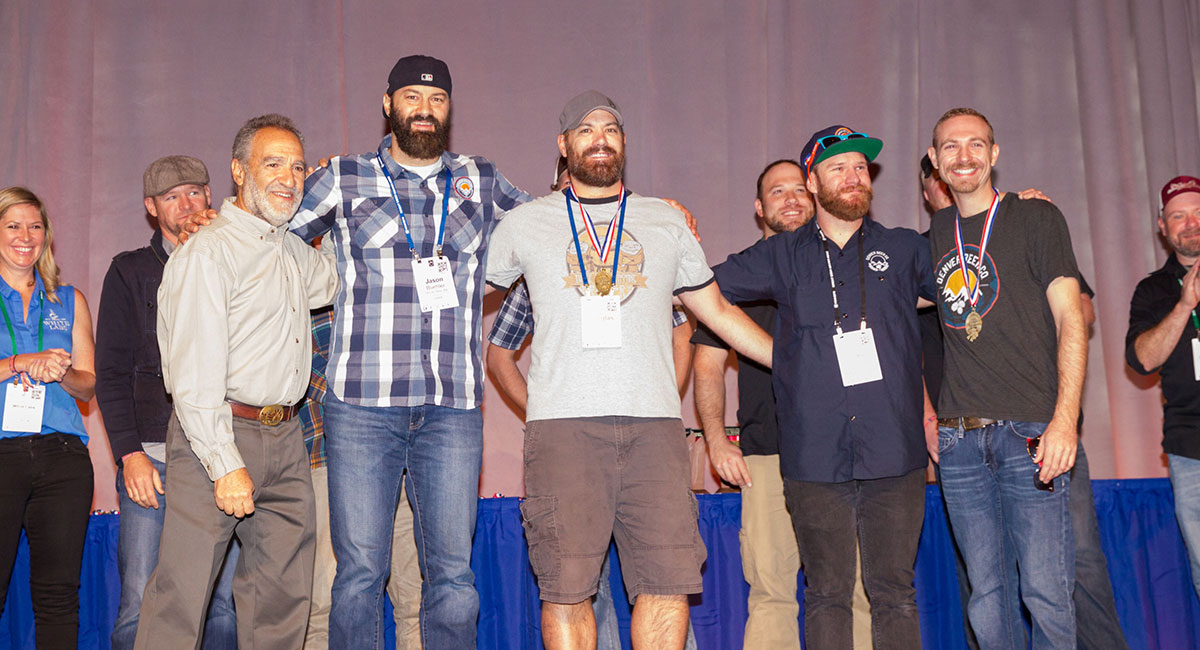
Only three of the 118 homebrewers are dubbed GABF medal winners, and in 2017 all three happened to live in Colorado. In the midst of their fame and glory, we got to ask them about their GABF Pro-Am Competition experiences. Keep an eye out for the medal-winning recipes in the January/February 2018 issue of Zymurgy magazine.

Gold: Just Another Pretty Face

  • Style: English Barleywine aged in Whiskey Barrels
  • Brewery: Denver Beer Co.
  • Brewmaster: Jason Buehler and Denver Beer Co. brewing team
  • Homebrewer: Doug Thiel

Silver: Lichtenhainer

  • Style: Historical – Lichtenhainer
  • Brewery: Black Bottle Brewery
  • Brewmaster: Black Bottle Scuba Squad
  • Homebrewer: Daniel Tomkins

Bronze: Exulansis

  • Style: American Sour Ale with Raspberry
  • Brewery: Odell Brewing Co.
  • Brewmaster: Odell brew team
  • Homebrewer: Mark Boelman

ProAm Gold

Great American Beer Festival (GABF) Pro-Am winners Denver Beer Co. pose for a celebratory picture with American Homebrewers Association founder Charlie Papazian.

Scaling up a Homebrew Recipe

Daniel Tomkins: I had some great advice from a pro brewer friend, which was to be very particular on any ingredients that are essential to the character of the beer. This is entirely the approach I took, mostly deferring to the brewers at Black Bottle Brewery because they know their system and how recipes will translate on it much better than I possibly could.

Mark Boelman: Odell did a spot-on job with the recipe and ingredients. However, there were some differences to note. The original recipe had a mash cap, compared to Odell’s recipe which mashed everything. The homebrew recipe was no-boil. I heated the wort to 185° F (85° C) and held it there for 15 minutes with a very low hop dosage. Odell did a full-boil schedule and a 60-minute hop addition, as they’re familiar with how their sour bacteria would perform. Odell also fermented the beer with clean brewer’s yeast before moving it over to Friek barrels to age and sour with the culture already living in the wood. The homebrew recipe had Lactobacillus and a large pitch of Brettanomyces.

Doug Thiel: The scale-up process was pretty easy. I kept all the ingredients in percentage so I could pass the recipe along to other homebrewers. Having everything in that format allowed for easy manipulation and efficiency testing of the recipe. So in effect, Denver Beer Co. was able to just plug in the numbers and go with it.

ProAm Black Bottle

Black Bottle Brewery, GABF Pro-Am silver medalists.

Origins of a Beer Name

Tomkins: The beer was the historical style Lichtenhainer, which struck my interest for a couple reasons. First, I find beer history and historical beers to be wildly interesting and a fun challenge in general. Second, I had previously brewed Lichtenahiner’s small, sour German brothers, Berliner weisse and gose, and wanted to have a go at finishing the set. Guess it worked out pretty well!

Boelman: We spend a lot of time developing beer names at Left Hand Brewing Co. With so many breweries springing up and increasing the number of beers being produced, finding an original beer name is tough. Exulansis comes from the Dictionary of Infinite Sorrows (an online dictionary of words that haven’t yet made it to the real dictionary) and is defined as “the tendency to give up trying to talk about an experience because people are unable to relate to it.”

Thiel: The original name for the beer wasn’t exactly marketing-friendly, so I ended up changing it to Just Another Pretty Face. A friend of mine and I also use that as the name of our home brewery, and it is also a lyric in a Grateful Dead song, “Althea.” I tend to jam out while I brew, and the name brings my love of music and brewing together under one roof.

ProAm Odell

Homebrewer Mark Boelman celebrating his GABF Pro-Am bronze medal victory.

Advice for Aspiring Homebrewers

Tomkins: I don’t feel as though I’m in any position to give advice to other homebrewers as I’m very aware of just how many people out there are far more talented and deserving than I am, but the little bit of advice I’m willing to impart is simply to not be afraid to experiment and try different ingredients, methods, and styles!

Boelman: One word: enter. First and foremost, don’t approach a competition with the expectation of pulling down a medal. You should go in with an open mind that you are going to get quality feedback about your beer that you can use to improve something down the road.

I am also a big advocate of joining a homebrew club. I can honestly say for me and my fellow club members (Loveland Weiz Guys and Gals) if you want to take your beer to the next level, you need to find a collective group of like-minded homebrewers who will help each other. My beer and our club’s beer have all been elevated because of this: our small club of 35 people had four beers being poured at GABF this year.

Thiel: Patience is key. Once you think its ready, give it at least another month, or two, or six. And surround yourself with other homebrewers that are putting out great-tasting brew. You’ll learn an amazing amount of information from fellow beer lovers, especially if you are on the newer side. For me, all-grain was as daunting as it could get, but it wasn’t until I was able to watch and listen to a bunch of homebrewers doing a batch that it all clicked.

As for competitions, enter them and enter often. Read the guidelines and then re-read them. The feedback from the judges was great and helped me iron out recipes on numerous brews. When you do make changes to a recipe, make only one change at a time. That way if you don’t like it, you’re not wondering which change you didn’t like.

The post Q&A with the 2017 Great American Beer Festival Pro-Am Winners appeared first on American Homebrewers Association.

Posted on

Double Black Imperial Black IPA

Mash grains at 153°F (67°C) for 60 minutes. Ferment at 68°F (20°C).

Notes: Be aware that you will lose quite a lot of wort to the massive amount of hops. If you can exceed 75 percent efficiency, try to collect extra wort. But don’t over-sparge. You will need to use a yeast starter for this brew. If possible, use pure oxygen when pitching yeast to reduce the ester profile.

The post Double Black Imperial Black IPA appeared first on American Homebrewers Association.